Mining operations driven by cleaner freight practices and broader sustainability initiatives
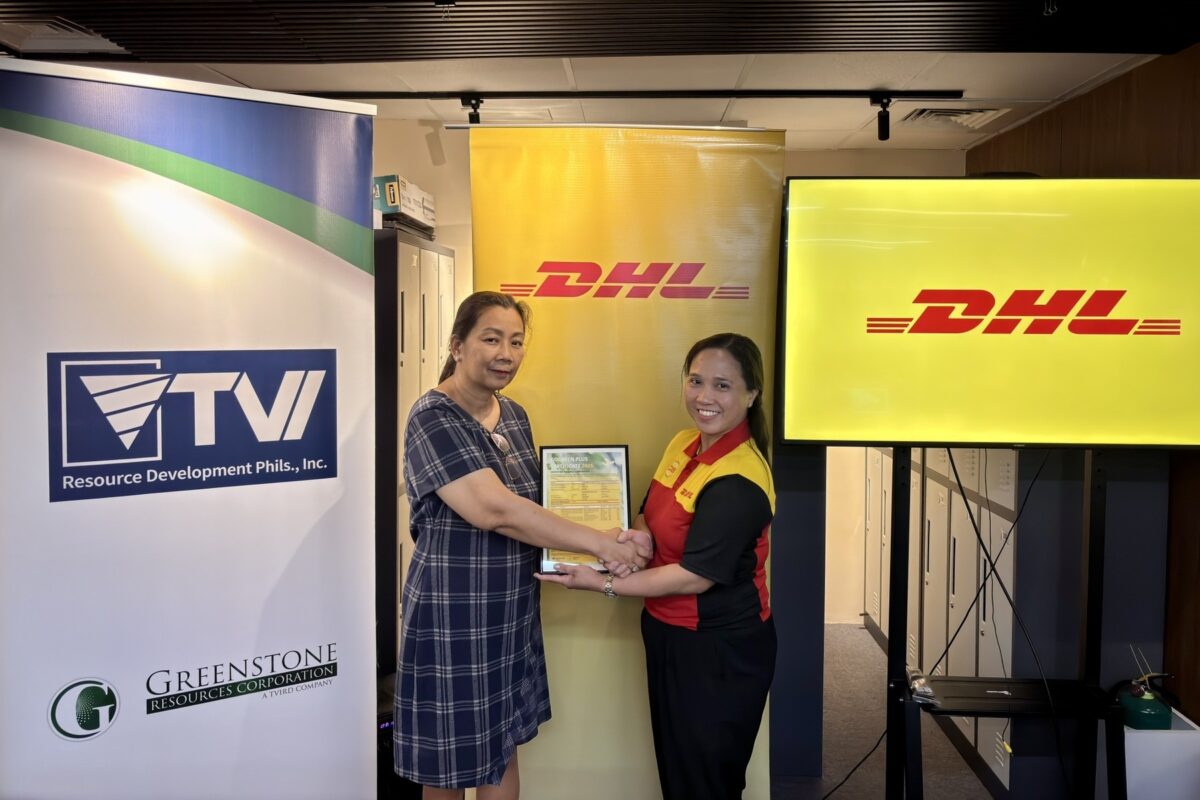 TVIRD Controller Erma Abalos (left) receives the DHL GoGreen Plus Award from DHL Area Sales Manager Joy Balazon.
Makati City / May 2026 — Packages now arrive before most people finish their morning coffee. Machineries and critical spare parts can be flown in overnight from remote sites. Contracts and permits cross borders in hours. Speed has become almost invisible — so have the emissions it leaves behind. In modern logistics, delivery performance is easy to measure. The carbon produced in transit rarely is.
Logistics in focus
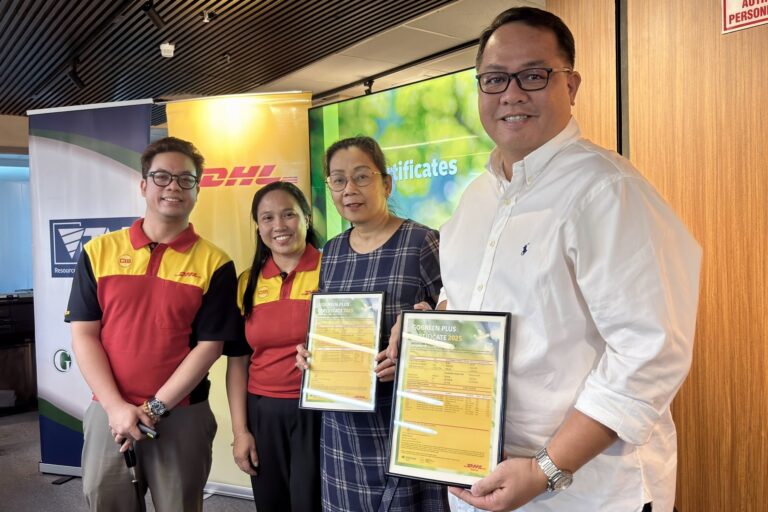
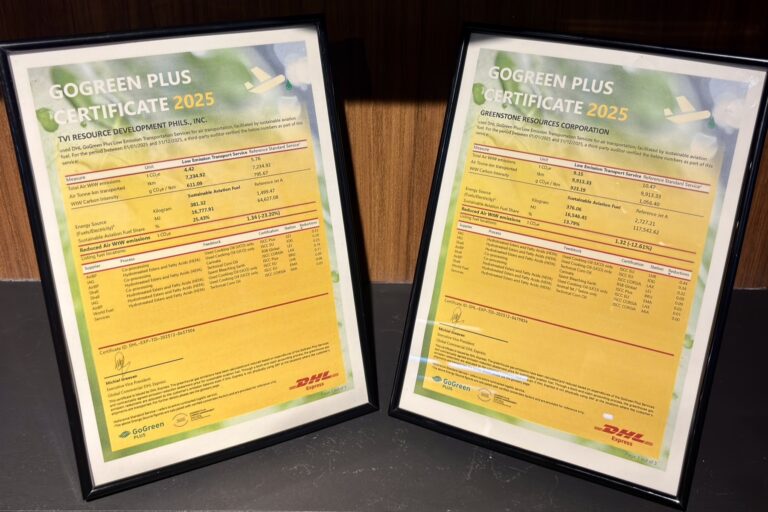
That often-overlooked layer of movement recently took center stage for TVI Resource Development Philippines Inc. (TVIRD) and Greenstone Resources Corporation, whose respective Balabag and Siana projects received the DHL GoGreen Plus Award for participating in lower-emission shipping initiatives.
“We are deeply heartened by this recognition, which validates that TVIRD’s sustainability initiatives are the right one. It likewise underscores that the company’s investments into energy conservation are delivering positive returns,” said TVIRD Group Financial Controller Erma Abalos.
The citation was presented by DHL Philippines at the TVIRD Makati office on April 29. It recognizes participation in DHL’s GoGreen Plus program, which enables customers to reduce logistics-related emissions through the use of Sustainable Aviation Fuel (SAF).
SAF is produced from waste-based feedstocks such as used cooking oil, animal fats, solid waste, agricultural residues, and woody biomass. DHL says SAF can reduce the lifecycle carbon emissions of air transport by as much as about 80 percent compared with conventional jet fuel.
Emissions in transit
For mining operations such as TVIRD’s and Greenstone’s, logistics is inseparable from daily work. Equipment, parts, supplies, and documents move in and out of remote sites continuously — each shipment keeping the company in motion. It is also where emissions quietly build up, one package and one shipment at a time.
These impacts typically fall under Scope 3 emissions — indirect emissions generated across a company’s value chain, including transportation and distribution. For many organizations, Scope 3 represents a substantial portion of total emissions and is among the most challenging categories to measure and manage.
Measured reductions
Under GoGreen Plus, shipments linked to both projects use SAF-supported logistics solutions, resulting in measured emission reductions of 23.20 percent for TVIRD and 12.61 percent for Greenstone.
The results build on the TVIRD Group’s broader sustainability framework, which includes carbon compensation initiatives, reforestation efforts, and environmental compliance systems across its Balabag and Siana operations.
Separately, in a program with Shell Philippines, both projects were previously recognized for retiring carbon credits tied to reforestation-based offsetting, reinforcing an approach to emissions management that extends beyond operational sites.
Sustainability in motion
Taken together, the initiatives reflect a broader shift in how sustainability is defined in extractive industries. The focus is no longer limited to rehabilitation or production practices; it increasingly includes how materials move — and how resources are transported before and after extraction.
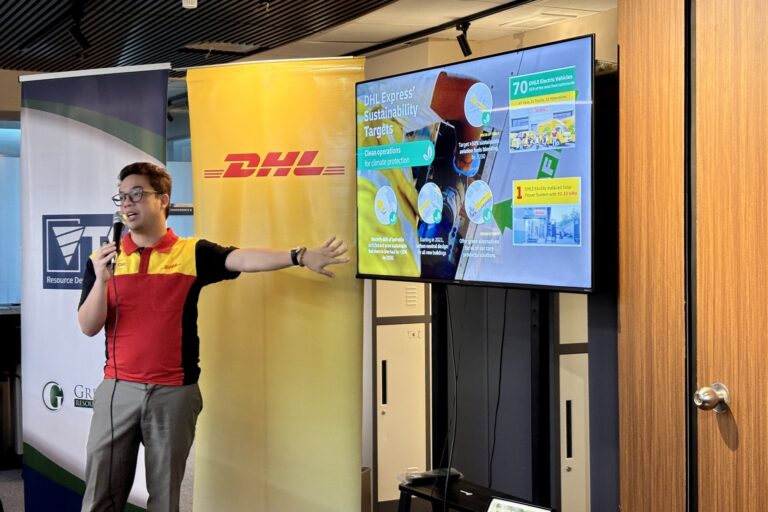
During the program, DHL Philippines Field Sales Executive John Paul Perez, stresses the importance of the DHL GoGreen Plus award in recognizing the TVIRD Mining Group’s efforts to help lower aviation fuel usage.
“TVIRD and Greenstone were recognized for joining DHL’s GoGreen Plus program, which supports lower-emission shipping through Sustainable Aviation Fuel. Their participation reflects a practical commitment to reducing logistics-related emissions and advancing sustainability across their supply chain,” Perez said.
DHL launched GoGreen Plus as part of its wider push to decarbonize logistics through customer-driven insetting models, amid growing expectations from regulators and customers for clear, verifiable emission reductions. In industries where supply chains stretch across long distances, TVIRD’s participation signals a growing view that responsibility does not end at the mine gate. It extends into the logistics networks that keep operations running.
Sustainability, in this context, is measured not only by what remains on the ground — but also by what moves, and the emissions generated along the way.
*******